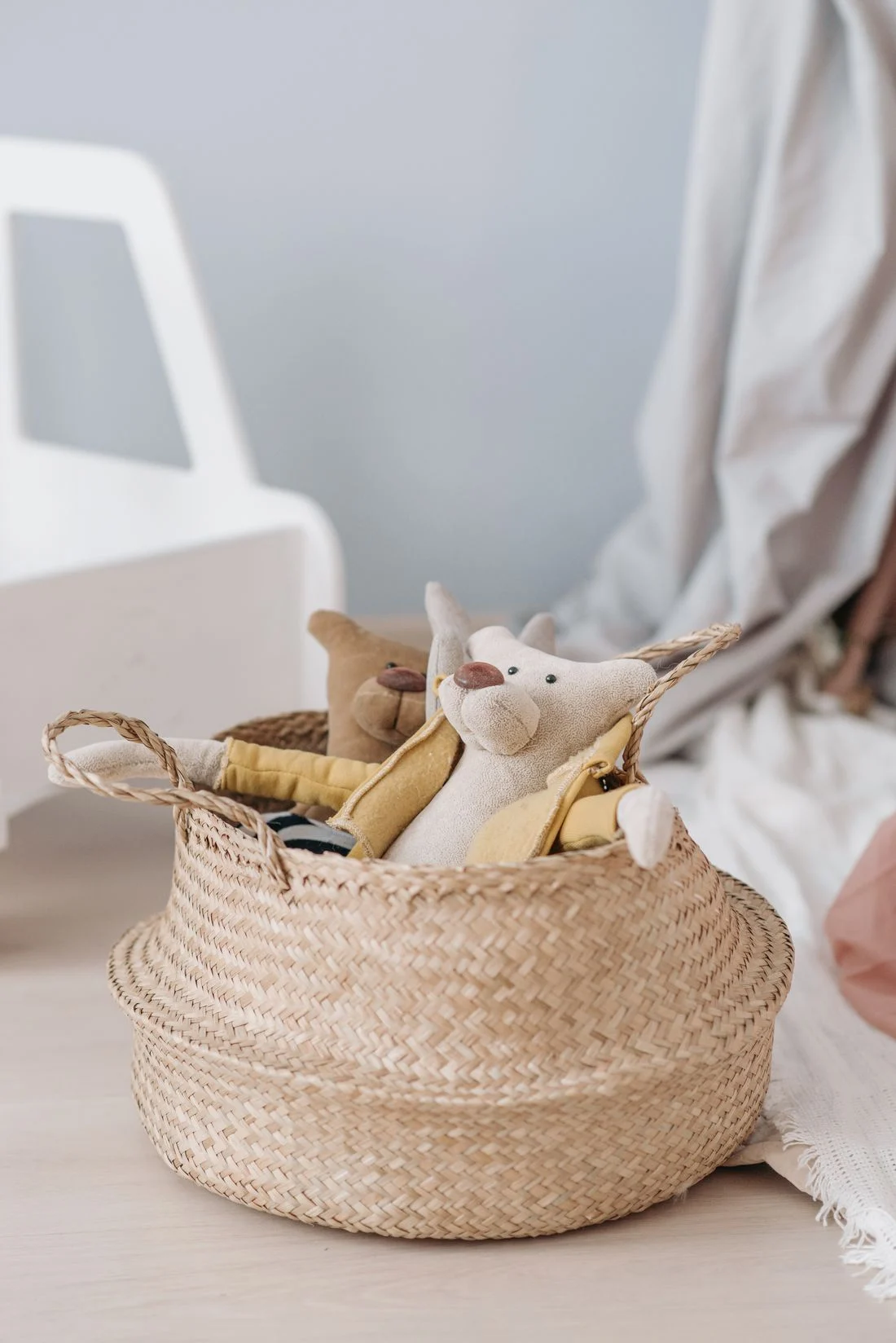
A toy basket works when putting something away is nearly as easy as taking it out. If every piece must be fitted into a specific tiny compartment, the system may suit an adult's photograph more than a child's play. Start with broad categories that make sense to the people using them.
Soft toys, blocks, vehicles, and pretend-play pieces often need different containers because their shapes differ. Keep small parts appropriate to the child's age securely separated, and follow the toys' safety guidance. An open basket is not suitable storage for every item in a household with younger children.
Match the container to the contents
A flexible basket can hold soft toys without needing exact arrangement. Small building pieces may be easier to manage in a rigid container with a suitable lid. Choose a size that can be moved comfortably when full rather than the largest size that fits the shelf.
Check for rough edges, loose handles, and unstable lids. A basket should not become a climbing aid or sit where pulling it down brings heavy objects with it. Any furniture used for toy storage needs the manufacturer's required anchoring and stability measures. CPSC's Anchor It campaign emphasizes the danger of unsecured furniture tipping over.
Make the categories visible
A plain word label can work for older readers; a simple picture may be clearer for younger children. The label should describe what goes inside without requiring an elaborate distinction between nearly identical toys. If two categories are continually mixed, combining them may be more sensible than repeatedly correcting the household.
Keep the storage near the usual play area when possible. Carrying every toy to another room adds a step that makes cleanup less likely. A small active collection in the living room can coexist with reserve toys elsewhere, provided the boundary is easy to understand.
Leave room to put things back
Do not fill baskets to the point that each toy must be compressed or arranged precisely. Some free space makes cleanup faster and prevents the contents from spilling as the basket moves. A container that is always overflowing may need fewer active toys or a different size, rather than a decorative cover to hide the problem.
For sets with many parts, keep the main pieces and instructions together. A project that is still in use can have a temporary tray or shelf so cleanup does not mean dismantling it immediately.
Review during ordinary use
Notice which baskets are repeatedly ignored. Their contents may no longer be interesting, their location may be awkward, or the category may be unclear. Adjust one of those factors before purchasing more storage.
A workable toy system can look lived in. The useful measure is whether the floor can be cleared, favorite things can be found, and putting them away does not require an adult to reconstruct a display every evening.