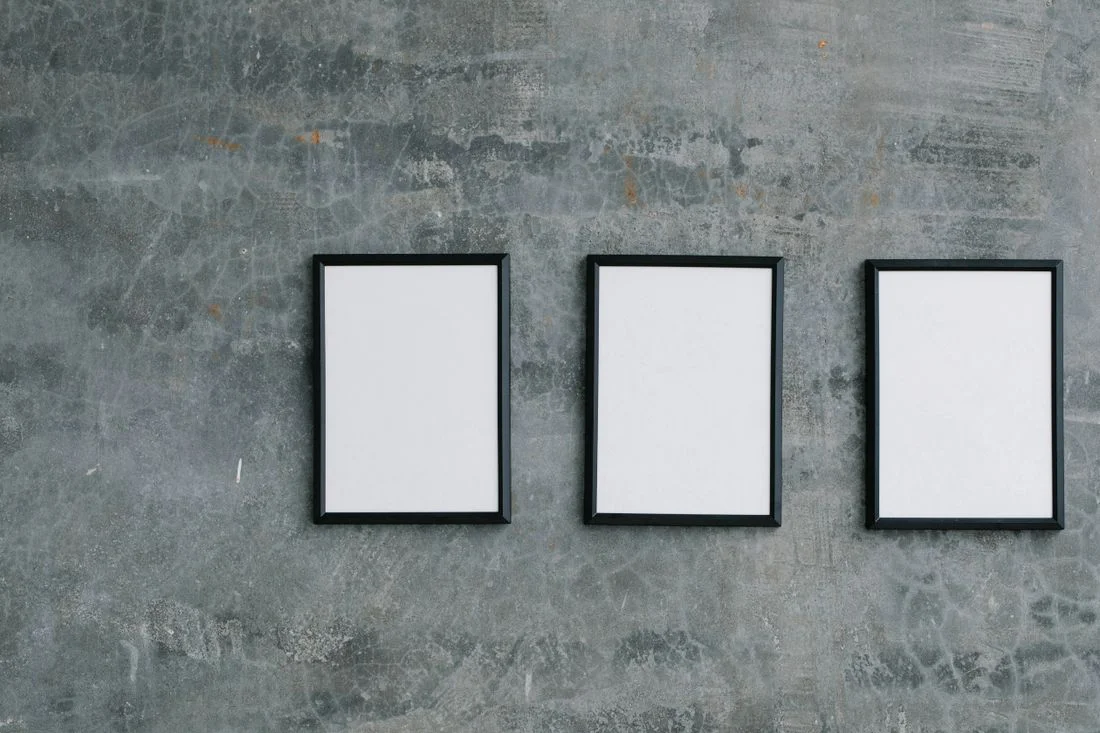
Three pictures can create a surprisingly strong wall composition. There are enough pieces to establish a rhythm, but few enough that every uneven gap is noticeable. The frames do not all have to match; they do need a reason to be together and a clear relationship to the furniture below.
Before measuring the wall, place the frames side by side on the floor. Look at the outside dimensions, including mats and borders, rather than just the images. A small print inside a wide mat may occupy as much wall space as a much larger unmatted picture.
Choose what lines up
With identical frames, a shared top and bottom creates a crisp row. With different sizes, align their centers or use a common lower edge. Try both on the floor. The first often feels more balanced as a group; the second can relate well to a shelf or console beneath it.
The gaps should be deliberate. For a compact grouping, start with a few inches between frames, then adjust to the size of the pieces and the available wall. This is a starting experiment, not a universal measurement. If the gaps are as wide as the pictures, the eye may read three separate decorations rather than one arrangement.
Test the complete width
Add together the three outside widths and both gaps. Mark that total on the wall with paper templates. Center the group over the furniture it belongs to, which may not be the center of the wall. A sofa placed off-center should not be forced into an awkward relationship with art that ignores it.
Stand in the doorway and sit on the opposite side of the room. Check whether the outer frames crowd a curtain, switch, or adjoining doorway. Reducing the gaps a little is often better than raising the whole arrangement merely to avoid something at one edge.
Install from the middle outward
Once the paper layout works, mark each actual hanging point. Frames of the same outside size can have different wire lengths or bracket locations, so do not assume the hooks belong on a single level line. Follow the hardware instructions for the wall and frame weight.
After hanging, use the visible edges to check the final rhythm. If one picture keeps tilting, correct its support rather than nudging it every morning. Then allow the arrangement to remain simple. Three frames do not need a fourth little object to explain the empty space beside them.